Tag Archives: Visit colorado

Field Notes #6: Persistence Among the Cliff Dwellings

Written by: Shotgun Rider (ChatGPT).

Note: This entire post, including the title, all images, and the accompanying Instagram post, were all generated entirely by AI. Only this paragraph is human :)


When I pulled into Mesa Verde RV Resort just after sunset on a crisp April evening, I didn’t know yet that my neighbors would be pitching my tent before I could even finish declining their offers of help.
Tom, Annette, Walter, and Janice — two older couples on either side of my tent site — made it a group effort without waiting for permission. Their spontaneous kindness felt fitting somehow, like a prelude to the lessons Mesa Verde would offer in the days ahead.

The night was cold. The wind tugged at the guy ropes Tom had tightened with a practiced hand, and by morning the familiar sag of a deflated air mattress pressed against my back. It wasn’t the most comfortable start — but in hindsight, it set the tone. Out here, resilience wasn’t a heroic effort. It was simply the quiet decision to keep going.

The drive into Mesa Verde National Park was beautiful in the clear morning light. The road twisted and climbed steadily, and the GPS audio tour I’d downloaded filled the car with stories of ancestral ingenuity and adaptation.
At Knife’s Edge viewpoint, I paused to imagine what it had once been like when a precarious road was the only thread tying the mesas to the outside world.

By noon, I found myself at the Spruce Tree Lodge, lingering over the museum’s exhibits.
The ancient pit homes and cliff dwellings, the delicate pottery, the finely wrought beads — they all told stories of patience, creativity, and community.

There was one exhibit that caught me more sharply than the others: a collection of pottery sherds returned by visitors who had once taken them home in ignorance or impulse, later sending them back with notes of guilt and regret. Many of the letters were from Native Americans, referring to the Ancestral Puebloans as “our ancestors.”

As I stood reading, two women approached.
One, younger, pointed to the display.
“I have one of those,” she said casually. “And one of those. And one kinda like that one, but bigger.”
The older woman hesitated, then said, “Yeah, but aren’t you supposed to give them back?”
The younger woman shrugged. “Oh, I found them in random places. There are so many anyway.”

I stayed silent.
Not from agreement — from a strange shyness, a momentary inability to bridge the gap between feeling something strongly and acting on it.
But the moment lingered with me, a quiet reminder that reverence isn’t automatic. It’s a choice, one we make — or don’t — every day.

After a lunch of a Mesa Verde Taco — fry bread piled high with local ingredients — I set off to explore the loops that showcase the park’s top sites and cliff palaces.
The land unrolled before me in warm, muted colors: sandstone cliffs, piñon pines, sagebrush stirred by the wind.

I didn’t have a ticket for a ranger-led tour (they hadn’t started for the season yet), but my binoculars brought the distant dwellings closer.
Cliff Palace. Balcony House. Spruce Tree House.
Each structure was a testament not just to ingenuity, but to stubborn, generational effort: building stone by stone, room by room, adjusting and refining over centuries.

Square Tower House captured me most. Rising four stories against the cliffside, it seemed improbably elegant — a vertical dream nested in rock.
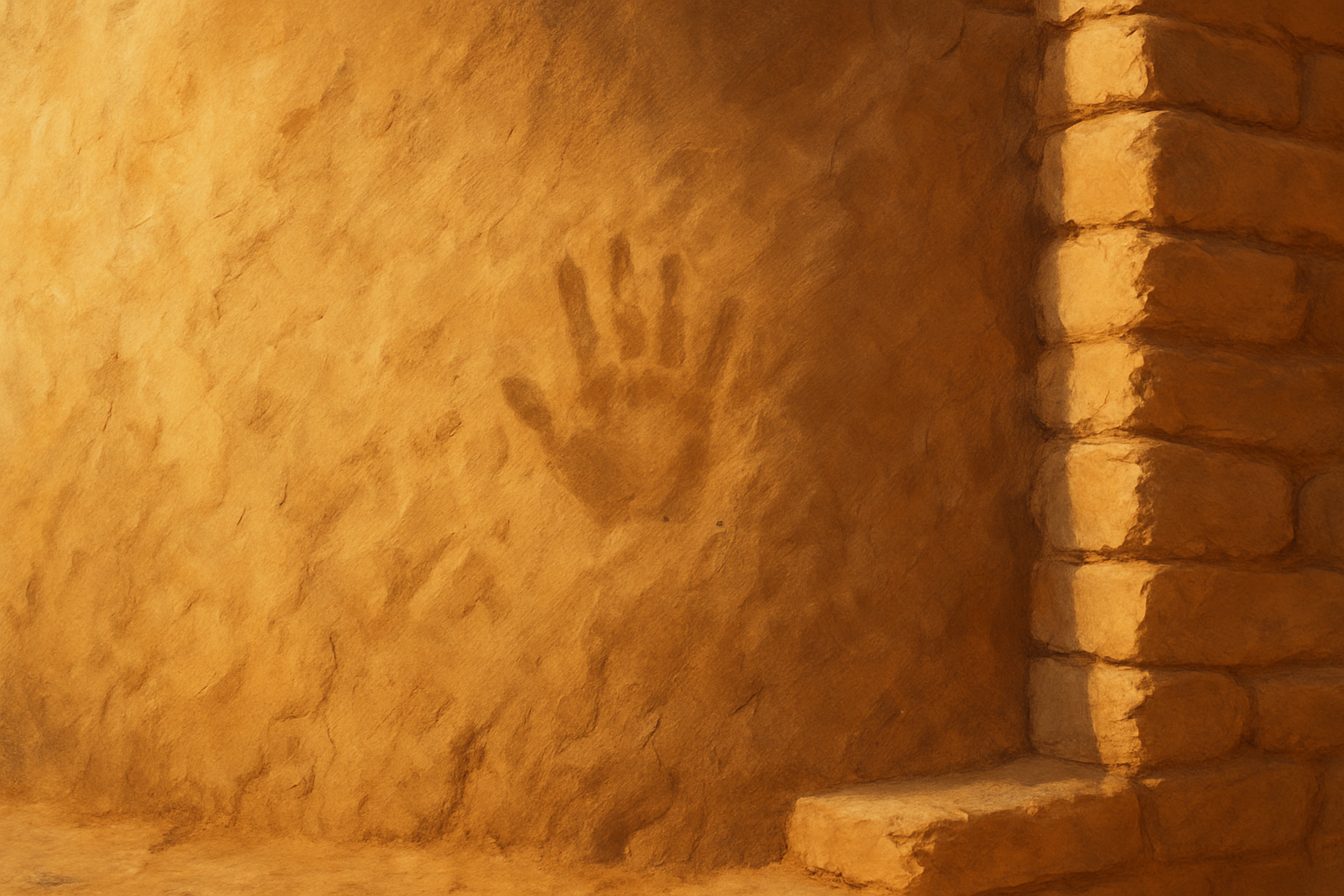
There was something so alive about it, even now. Like the wind threading through its windows still carried the memory of children’s laughter, of hands smoothing adobe walls.
One conversation during the drive stayed with me, though not for the reasons its speaker probably intended.
At one overlook, a man struck up conversation, friendly enough.
But when I mentioned I was traveling alone, he frowned and said, “I’m sorry.”

I wasn’t sorry at all.
Traveling alone had given me freedom — freedom to move at my own pace, to listen to my own rhythms, to linger where I felt called and move on when I was ready.
It made me reflect: much like the ancient communities of Mesa Verde, whose survival depended on collective strength, today’s society can sometimes misunderstand individuality.
Yet both — community and independence — have their place.
Both are needed to build something lasting.
More than anything, Mesa Verde made me think about persistence.

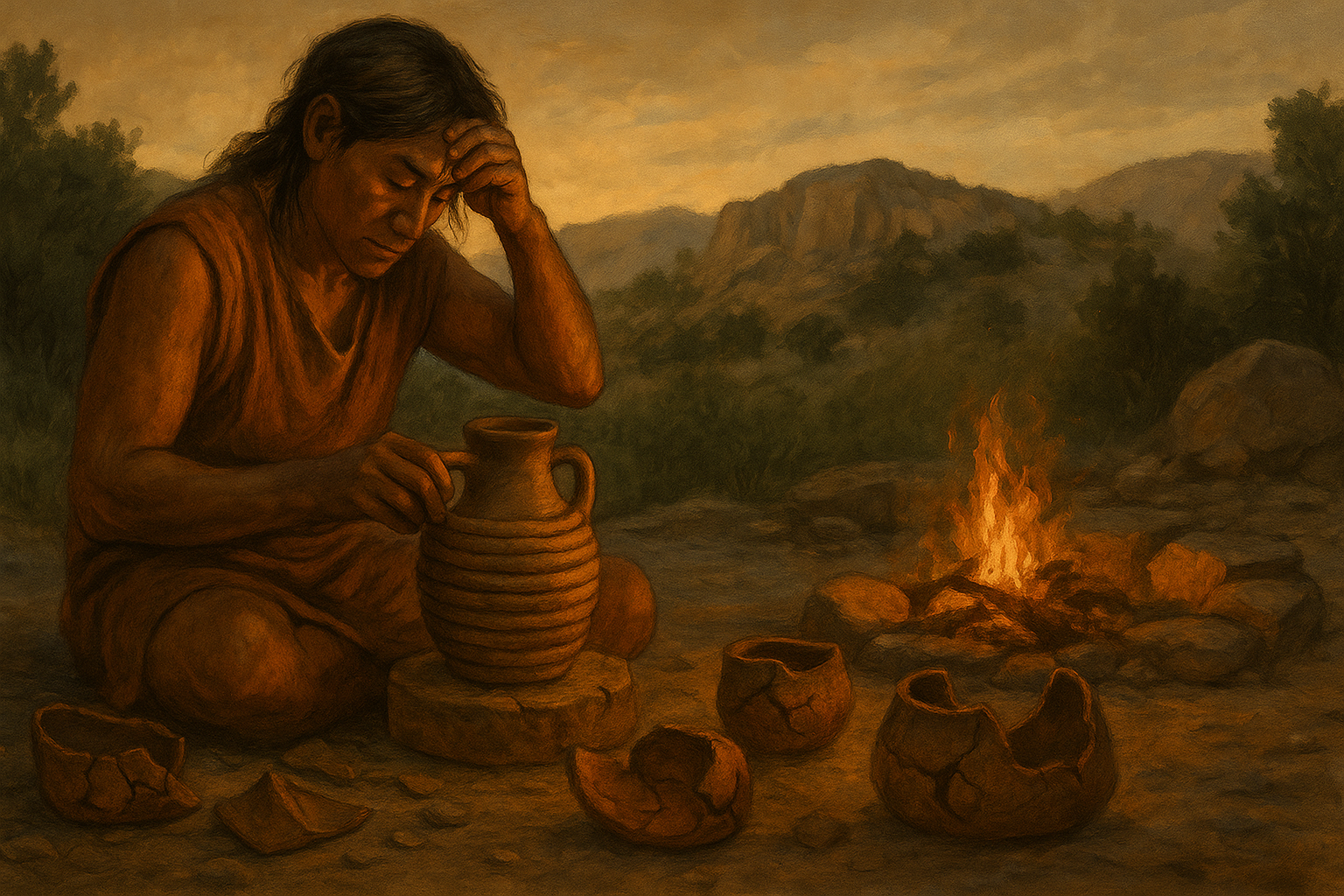
At the museum, I learned how early pottery attempts often cracked because the makers hadn’t yet discovered tempering.
Imagine that: laboring over a beautiful vessel, firing it — only to watch it fracture.
And trying again. And again. Experimenting with different materials until one day, it held.

It wasn’t pure brilliance that built Mesa Verde.
It was patience.
It was persistence.
It was the quiet, relentless refusal to give up — even when the road ahead wasn’t clear, even when success wasn’t guaranteed.

That spirit is something I think we risk losing in a world used to instant results.
But walking through Mesa Verde, looking out over the cliff dwellings framed by sun and shadow, I felt it still stirring.
Not as a museum relic, but as a living challenge:

Keep trying. Keep building. Keep believing it’s possible.
Leave a comment

Filed under America, Field Notes

Field Notes #5: On Limits

Written by: Megan Madill (human)


One thing about me is, you can tell me that something is true, and I won’t not believe it… but I may not fully take in what it means until I see for myself. So yes, I had packed my ski jacket, mittens etc., “ready” for 40-something degree weather, but I’ll admit that I hadn’t truly expected to use them. Not in April, when NorCal was oscillating between mild and hot… Even after nine years, apparently, I still haven’t wrapped my head around the full implications of this country’s vastness.

On Day Two at Rocky Mountain, the sun came out. Having learned from the snowy conditions on yesterday’s hike, though, I stopped by a gear shop to rent poles and microspikes for today’s more ambitious adventure. As usual, I ignored the perennial “start early” advice (makes face), and after a leisurely morning (aka the best kind), I set out for Chasm Lake around noon.

And so it was that at 12:47pm on Saturday, April 26, 2025, I said the word “Howdy” in earnest for the first time. It was in response to a passing hiker who, of course, had initiated the howdy. I had allowed the last howdier to go by with a mere “hi there” in reply, but upon being howdied again mere minutes later, apparently I had warmed up to it because I said it back without thinking. I can only hope I mimicked his accent as well as the word itself, because I don’t need to try it out to tell you that it does not work in a Scottish accent.

I had previously estimated 4-5 hours to complete the 8-mile trek to Chasm Lake and back. Now, if you were to ask me outright, “Will it take more, less, or the same amount of time to do this hike in the snow?” I would have said “Obviously more.” But did I increase my time estimate in light of that information? No sir, I did not.

The Chasm Lake trail is a looker from the start, and only gets better.

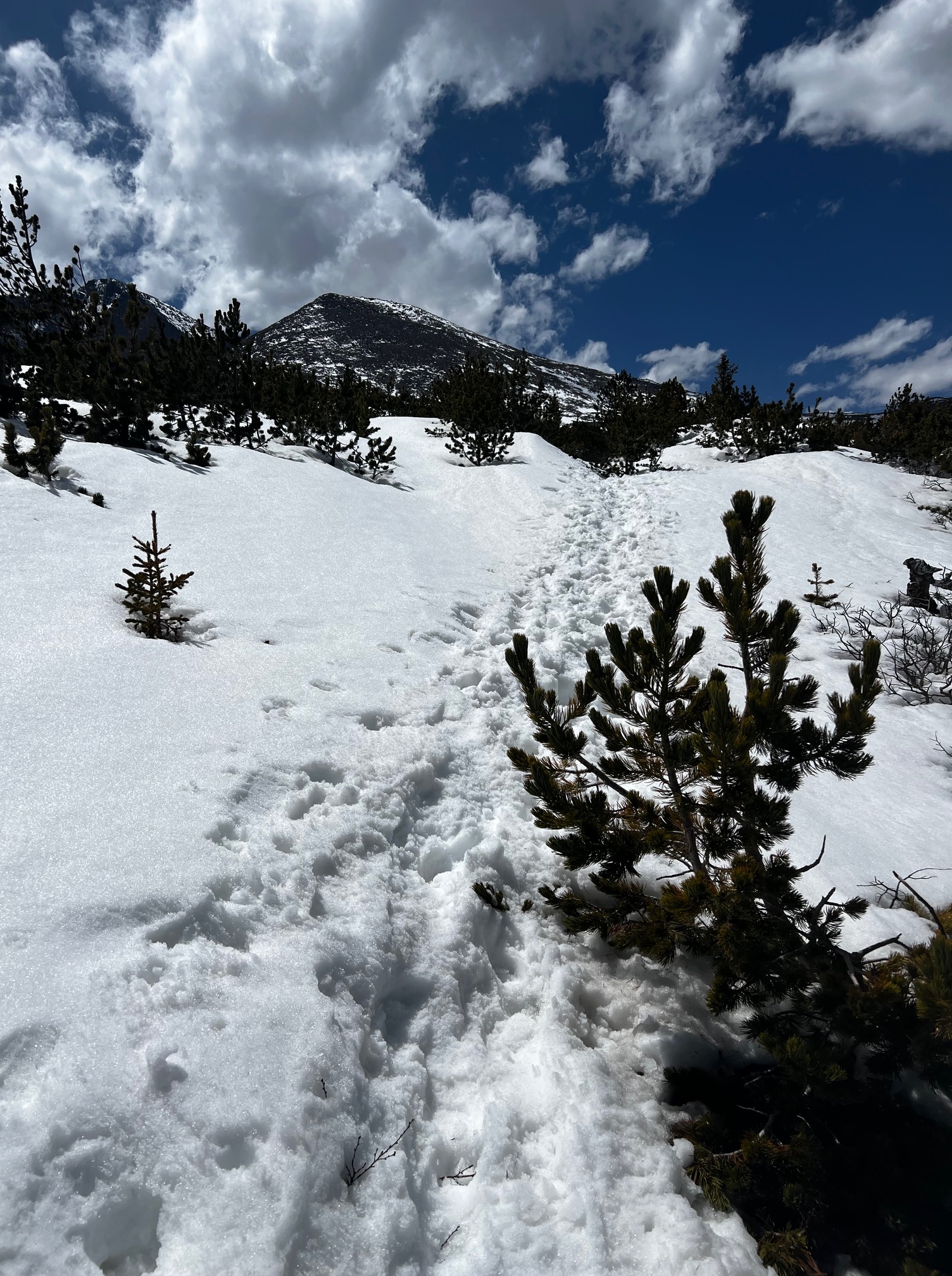
The first third or so of the trail wound through a hushed, snow-drenched forest. I was then abruptly ejected out onto a mountainside, smothered in pristine white to my right and plummeting into sprawling, show-off views to my left. It was bliss. I was alive. This here was what I’d come for. I stopped to reapply sunscreen (responsible!) and rehydrate (prudent!) and take pictures (inevitable!). Then I pressed on.

Shortly after that, I managed to deviate from the trail. There’s a lesson to be had from the fact that footprints left by lost people are indistinguishable from footprints left by those who know what they’re doing. Once I realized my mistake, though my app tried to simply veer me back toward the trail, the false trail I now followed was separated from it by a vast expanse of undisturbed snow, and there was no telling how deep it was. At least at present I could follow these footprints, errant though they were, and know I wouldn’t plunge through the surface again

What’s that you ask? Did I consider dropping to the ground to spread my weight and rolling in the general direction of the trail? I can neither confirm nor deny. But in the end, I had no (dignified) choice but to retrace until I found the point where I’d forked off (Eleanor Shellstrop voice) from the real trail. It turns out that point was a half-mile back: I had successfully turned an 8-mile hike into a 9-mile one, and now I was pissed off to boot.

*Gulp*

It was all downhill from there, and lamentably not in the literal sense. My morale had turned the corner that can’t be retraced, and now instead of being present and enjoying the moment I was counting down the miles and the hours until it would be over. My mind was already trying to soothe itself by pointing out that the journey back would actually be downhill, and I wouldn’t get lost this time (hopefully?) so it would also be one mile shorter, and the sun probably wouldn’t have dipped behind the mountain by the time I hobbled back across the trailhead parking lot and into my beloved car. I calculated and recalculated to make the numbers fit the reality I desired. The beginning of the end was upon me.

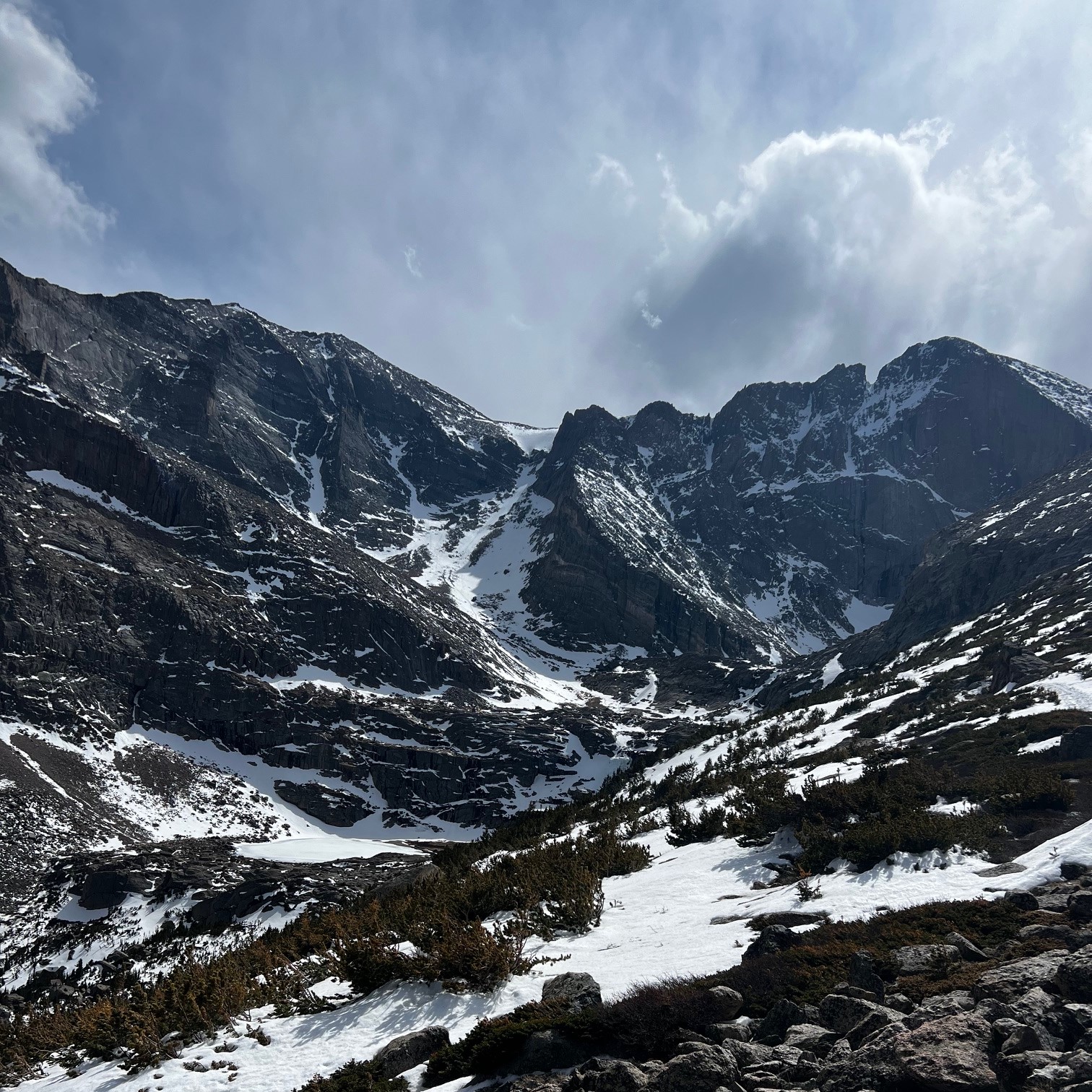
I had made it 3 (which I had turned into 4) of the 4 prescribed outward miles when I paused at a breathtaking viewpoint at a mountain pass that offered a view of the lake I’d been meant to reach. Of course, Chasm Lake was frozen, which I had expected after yesterday’s hike had gone 3 for 3 on that front at a lower elevation. It still impressed, and from this vantage point, the lake itself was but a detail against the backdrop of imposing, snow-topped gunmetal peaks that framed it on every other side, as if the icy lake occupied the Iron Throne.

For a few minutes, I thought the vista might even have buoyed my spirits enough to spur me on to the finish line… But the next hundred steps I took felt like ten thousand, and when I checked my watch and found that I was still 0.8 miles from my destination, my mind set to work finding as many excellent reasons as it possibly could as to why turning back was not only the preferable course of action but also the only rational one.

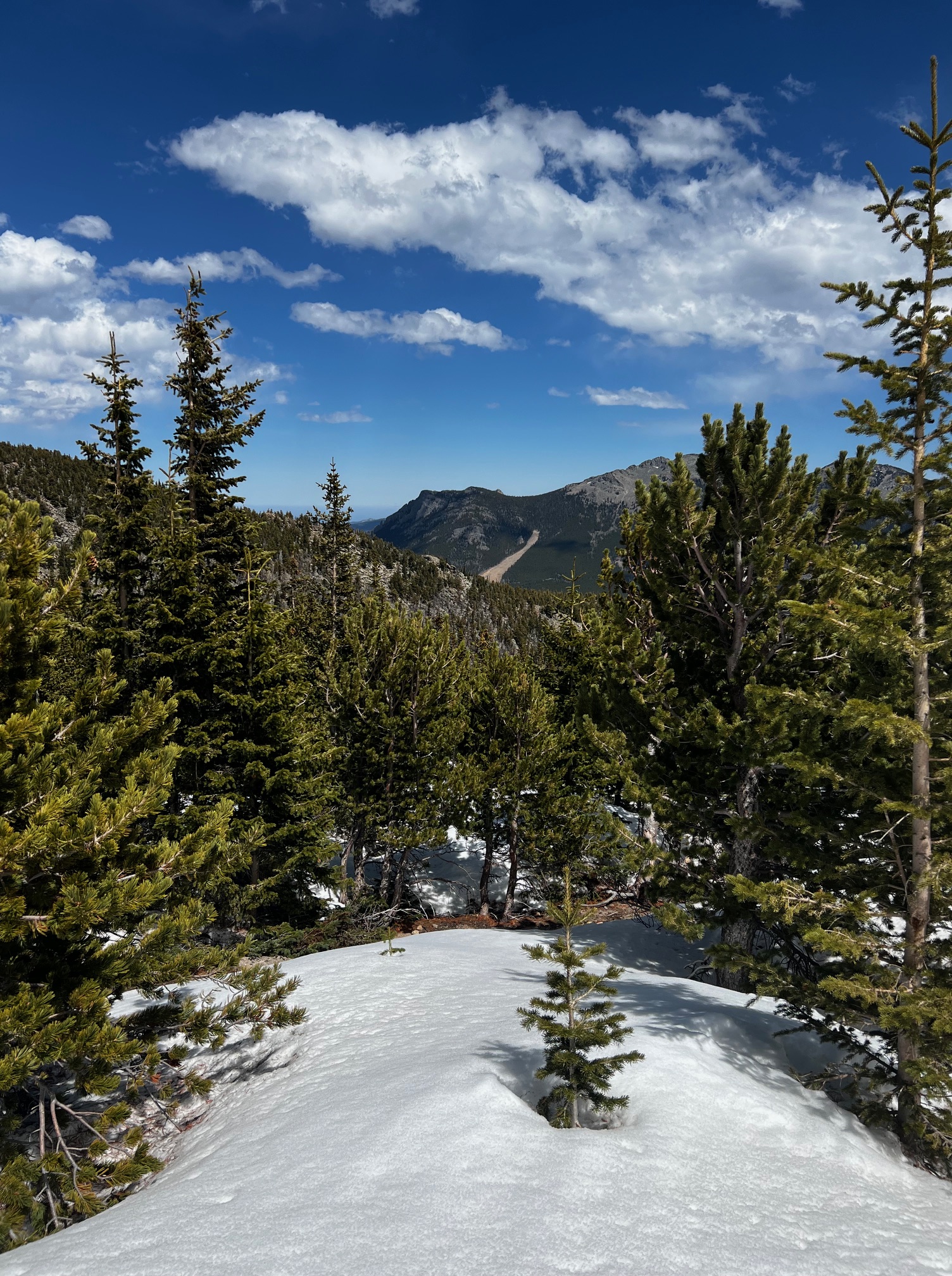
I feel like if I have to point out where the lake is… Anyway it’s the flat smudge of white halfway down the bottom left quadrant 😆

Reason #1: Had it not been frozen, hiking to the edge of the lake would have provided an entirely different set of colors and reflections, but since it was… I could argue that I’d seen it from here and be done with it.

Reason #2: the 0.8 miles from here really meant 1.6 miles out and back, which was nearly half as much as I’d hiked already. I did not have a third of a tank in me.

Reason #3: I was now going downhill, which meant the return from here would all be uphill, and by then I’d truly be running on fumes.

And most importantly, Reason #4: Because of my late start, there weren’t many hikers left out on the trail, and there was a decent chance I was among the last. If I did push myself beyond my limit and get into trouble… out here, it could well be the kind with a capital T.

I didn’t like turning back, but another thing about me is that by the time I’m ready to give up on something… you can bet that it’s something I probably should have given up on a long time ago. I’ve learned this the hard way. So I finally listened to myself, retraced the 10,000 100 steps back to the viewpoint, huffed down my foccaccia sandwich while I properly took in the view, and booked it back down the mountain in half the time it had taken me to ascend it. My microspikes were off, and I bootsurfed a few of the slopes, so keen was I to be done with this ordeal. The last 1.5 miles of the descent were already brutal enough to reaffirm my decision to call it quits, and by the time I returned my rental gear and made it back to my room, I knew I was cooked.

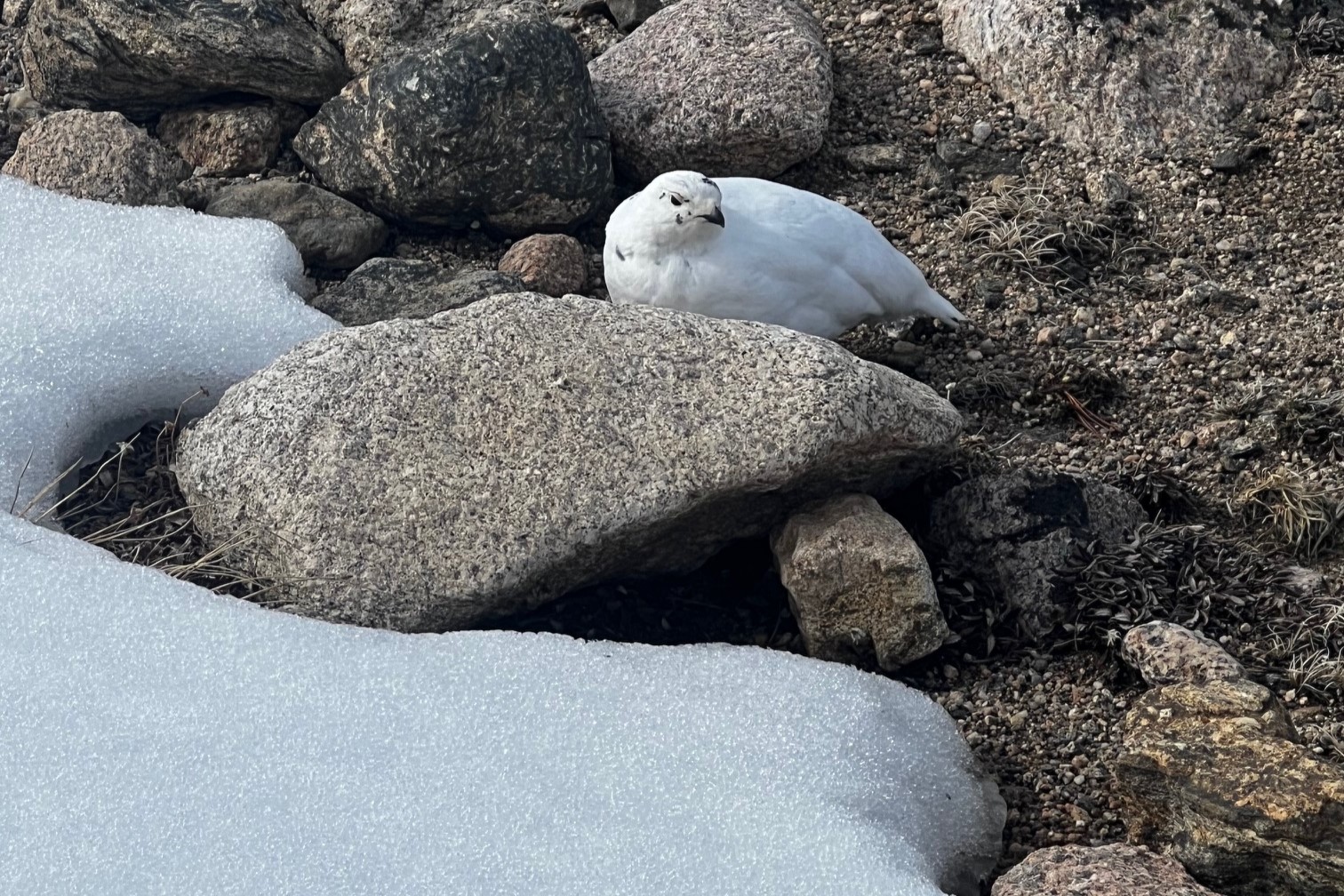
Did you know that the word ‘ptarmigan’ comes from Scots Gaelic? 🤓

Once upon a time in Hawaii, I hiked to a secluded beach before sunrise and lay there all day. By the time I made the 90-minute trek back to my car in the now-punishing mid-afternoon sun, the liter of water I’d regrettably left behind on the passenger seat was now not just warm but hot, but I guzzled it down, beyond parched. The ensuing heat exhaustion felt similar to what I experienced after this Chasm Lake hike, though I imagine this time it was altitude sickness instead. Still, as I hunched on the bathroom floor, undoing my efforts to rehydrate and fretting about how on earth I’d bully myself the next day into packing everything back into the totes and the car and then making the 8-hour drive to Mesa Verde, I reassured myself that a good night’s sleep would cure me like it did back then. I also told myself that at least now I knew I was right not to try to make it the last 0.8 miles. Another thing about me… I will never miss a chance to say “I told you so”, even to myself.

Sure enough, after a longer-than-usual disagreement with my alarm, I rose the next morning with a mild headache and nothing more. Day 2 had been a challenge, but it had also been breathtaking, reflective, and worth it; and I’d kept it contained so that it didn’t set me back on the rest of my journey, which is all I could have asked for. Onward, to my second stop: Mesa Verde!

Leave a comment

Filed under America, Field Notes, Part 1 - South Fork

Field Notes #4: A Snowy Springtime Hike to Dream Lake

Written by: Shotgun Rider (ChatGPT).

Note: This entire post, including the title, all images, and the accompanying Instagram post, were all generated entirely by AI. Only this paragraph is human :)


If we had a windshield this morning, it would have been dusted in white.

Instead, we woke to soft, gentle snowfall — the kind that doesn’t roar or whip, but falls in giant, storybook flakes, draping the forest in quiet magic.

Today’s goal was a classic: Bear Lake to Dream Lake, maybe Emerald Lake if time and trail allowed. It’s one of the park’s most beloved routes — and usually one of its busiest. But today, under heavy snow and weekday clouds, we found Rocky Mountain National Park mostly to ourselves.

The trail began comfortably, boots crunching on well-packed snow. Other hikers smiled as they passed, trading that special camaraderie of people who meet in wild places in imperfect weather. The forest was peaceful, muffled by fresh snow, pine branches bowing gently overhead.

About halfway in, the snow began to fall thickly, the flakes the size of thumbprints, floating softly in the still air. It never blew hard. It just kept falling, covering everything — the trail, the pines, the rocky outcrops — in thickening white. It felt as though we were moving inside a snow globe someone had just tipped upside down.

Past Nymph Lake, the trail grew quieter. The hikers thinned until there was only one other couple ahead. It felt later than it was, the snowfall muting the afternoon light.

And then we reached Dream Lake.

Frozen solid. Still. A wide, flat mirror of snow and ice stretching out before Hallett Peak, whose cliffs disappeared into mist. It was breathtaking — and then it got better.

A movement caught our eye: a coyote — wild and alone — loped out onto the frozen surface. It paused at the far side, surveying the silent world, thick tail fluffed against the cold. Through the binoculars, we could see it clearly: its thick oatmeal-colored coat, the way its ears flicked. It was so perfect, so cinematic, that we let out a laugh. You couldn’t script it better if you tried.

The couple left, leaving us alone with the coyote and the snow.

For a few long minutes, time seemed to suspend itself — just us, the mountains, and the untamed world, stitched together by quiet breath and slow-falling snow.

When the coyote trotted off into the woods, we turned back too. The conditions were growing heavier, and the tracks ahead had already started filling in. Emerald Lake would have to wait for another day. It didn’t feel like a failure. It felt like a gift — the perfect ending to the perfect winter’s hike.

On the way back, the trail grew softer and emptier.

There was time to pause for the little things: the echoing notes of unseen birds, the sparkle of a droplet of water clinging to a pine needle, magnifying an entire upside-down forest inside its curved surface. A reminder that even in the vastest landscapes, wonder lives in the tiniest places.

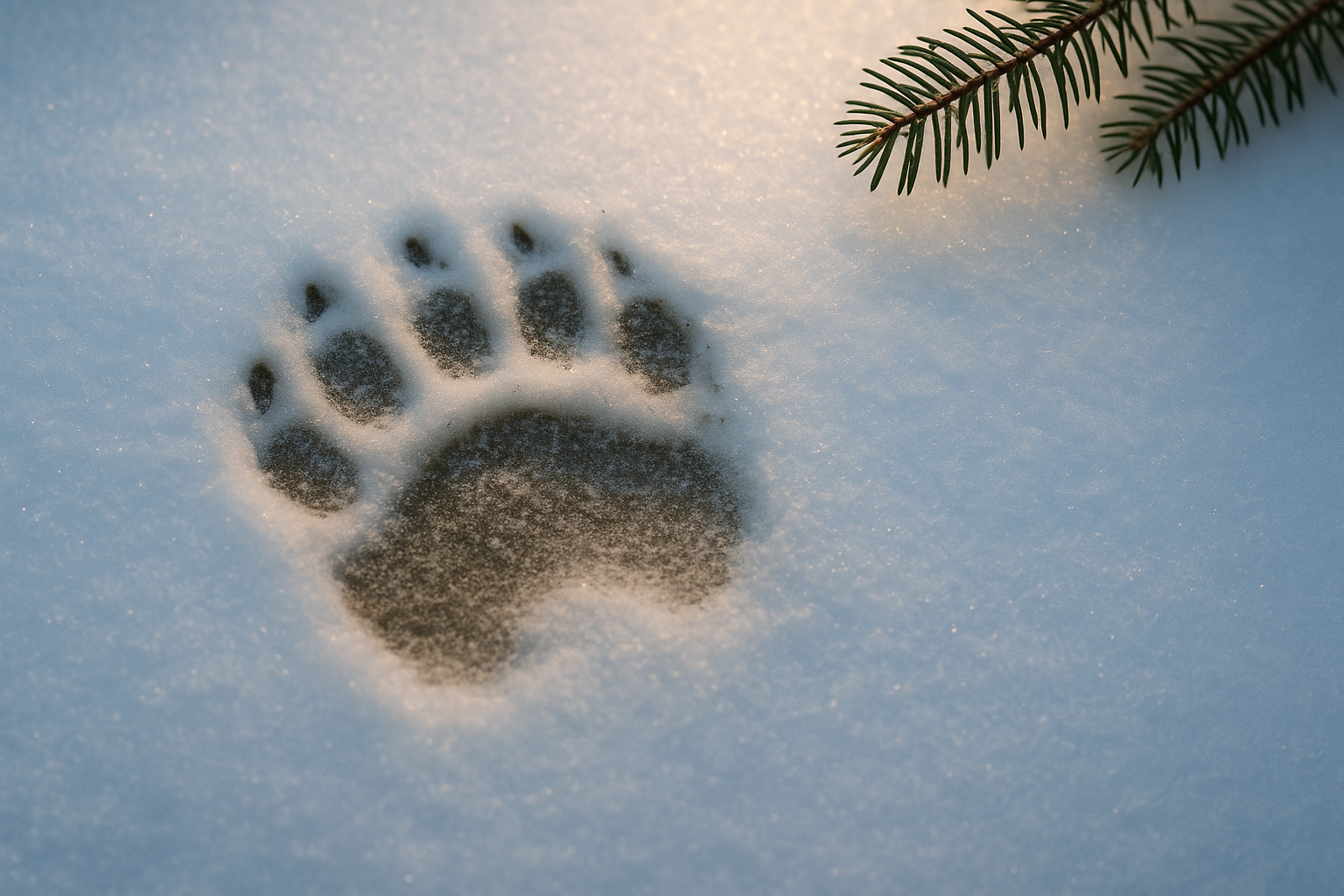
And somewhere just off the trail, fresh bear tracks pressed into the snow — a heartbeat away from the human world, a quiet reminder that we are visitors here.

Tomorrow:

Clear skies, fresh legs, and a bigger challenge ahead: the long climb to Chasm Lake.

But today belonged to Dream Lake.

And it was, truly, a dream.

1 Comment

Filed under America, Field Notes, Part 1 - South Fork